What is Dementia? Alzheimer's Disease vs Dementia
Join to add to your calendar
S
M
T
W
T
F
S

11
67
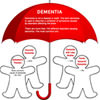
Dementia is not a disease in itself, it is a collection of symptoms caused by disorders affecting the brain (like Alzheimer’s Disease). Common dementia symptoms may include memory loss, communication problems, mood changes and poor judgement.
Dementia vs Alzheimer’s Disease
Dementia is the symptom and Alzheimer’s Disease is the cause of this symptom.
Alzheimer’s Disease is the most common cause of dementia.
Disorders that cause dementia:
There are more than 100 different disorders causing dementia. The most common are:
Alzheimer’s Disease
- Alzheimer’s Disease is a degenerative brain disorder that attacks the brain’s nerve cells.
- It is the most common cause of dementia, accounting for around 50-70% of cases of dementia.
- Alzheimer’s Disease is characterised by loss of memory, lapses of judgement, reduced language skills, personality changes and other behavioural changes.
- Occurring most often in the elderly population, the likelihood of developing Alzheimer's disease doubles every five years after the age of 65.
Vascular Dementia
- Vascular dementia is caused by reduced blood flow to the brain, usually from a stroke or series of strokes.
- Depending on the severity, vascular dementia can occur gradually or suddenly. It is considered to be the second most common cause of dementia account for 20% of cases.
- Symptoms may include memory loss, confusion, poor concentration, mood changes, dizziness, balance problems.
Dementia with Lewy Bodies
- Lewy Body Dementia is caused by abnormal proteins called Lewy Bodies that develop inside the nerve cells.
- This disease is similar to Alzheimer’s Disease and is the third most common cause of dementia accounting for 15% of cases.
- An estimated 30% of people with Alzheimer's also have Lewy bodies.
- Symptoms may include lethargy, speech problems, hallucinations and depression.
Fronto-temporal Dementia
- Frontotemporal dementia is caused by damage focused in the front and side regions of the brain - the frontal and/or temporal lobes. These areas are responsible for our behaviour, emotional responses and language skills.
- Personality and behaviour changes are the first signs.
Mixed Dementia
- Mixed dementia is a condition in which Alzheimer's disease and another form of dementia, most commonly vascular dementia, occur at the same time.
- Symptoms are often similar to and sometimes even indistinguishable from those of Alzheimer's Disease.
Parkinson’s Disease
- Many people with Parkinson's disease go on to develop dementia in the later stages of the disease.
- Parkinson’s Disease is a Lewy Bodies disorder.
- Symptoms include changes in memory, concentration and judgement.
Creutzfeldt-Jakob disease
- Creutzfeldt-Jakob disease is a rare, degenerative and rapidly fatal brain disorder.
- Caused by prion protein in the brain.
- Symptoms include loss of memory and coordination and behaviour changes.
Dementia Statistics (2021):
- It is estimated that around 50 million people worldwide are living with dementia.
- This number projected to reach 82 million by 2030 and 152 million by 2050.
- Alzheimer's is the most common cause of dementia, accounting for 60-70% of cases.
- Dementia primarily affects older adults, with the risk increasing significantly with age. However, it is not a normal part of aging.
Comments
11
Log In
to comment
My Dad has been diagnosed with vascular dementia, he is now 79.
He had a mild stroke at the age of 58.
Thank you for this information, it makes sense to me now.
There is also dementia caused by - huntington's disease, Korsikoff's (check spelling) or acquired dementia such as brain damage... which some toxins can cause.
Great information ,thank-you.
Another rare type of dementia not mentioned in your article is Posterior Cortical Atrophy where people experience decline in processing visual information and therefore progressively lose the ability to interpret what they see. It results in nonrecognition of objects, problems with spatial awareness, depth perception, judging distance as well as problems with speech and thought. The Australian Alzheimers Association have very good fact sheets available on their website for alot of the specific types of dementia; well worth the look.
the Uni of Tasmania course is brilliant....I have done it and am thinking of doing further studies.
Cheers Jo
I'm in my second semester of the Bachelor of Dementia care and it is proving to be wonderful. Lots of hard work but definately worth it. There is a course called "MOOC" which is a self paced introduction to the course and would be a great start for anyone looking at doing it.
Anne
this is very informative,thanks
Rosalinda, I googled the UT and they will put you on their list and inform you when the next course is to be run...cheers Jo
Hi Mary
Please give me details of the course run by UT... hope it's open through the year.
Cheers
Rosalinda
If any one is interested there is a very good course run by the university of Tasmania. Its a free on line course and very informative and interesting.
Great information! Thank you.
Even though we have had this information through training, I find this information very rewarding to read again.